4 min read
Why the smart cube is the future of speedcubing
Without feedback, a mistake can repeat for months. A smart cube can analyze everything and tells you what to fix.
Most cubers have always practiced the same way. Start a timer, scramble by hand while reading the scramble, solve, write down the time, repeat. Hundreds of times. It works: the fastest people in the world got there this way, and it still gets results.
But it has a flaw that is easy to miss, because everyone is used to it. It tells you almost nothing about what you just did.
A time, and nothing else
At the end of a solve you get a time. 14.32. Did the cross take three seconds because you planned it badly during inspection? Did you look for your second pair for a whole second? Did the AUF before your PLL cost two extra turns? The timer can't tell. A good solve with a botched PLL and a solve that was average from start to finish can end on the same time.
So you know you are improving, or stuck, without knowing why. And a bad habit settles in very quickly when you can't see it. You repeat it every solve, and after enough repetitions it becomes the way you solve.
The pair of eyes that changes everything
Plenty of cubers have had this moment. Someone faster watches you solve at a club or a competition and says one sentence: "you regrip before every pair", or "you always do U U' to recognize your PLL". You had never noticed. Ten seconds of advice, and a flaw you had carried for months is gone.
That outside view is probably the most effective advice there is in speedcubing. It has only one problem: it is far too rare. You need a club nearby, a competition, or a faster friend with time to watch several of your solves.
Scrambling, the lost time
Then there is everything between two solves. Reading a scramble and applying it easily takes ten to thirty seconds. Over an hour of practice, that is a good share of the hour spent not practicing, somewhere between 5 and 20 minutes. One mistake while scrambling, and you have to start over.
The problem is even clearer when you want to work on a single step. To drill your OLLs, you either set the cube up into a specific case or do full solves and hope it comes up. You spend more time preparing than practicing.
What a smart cube sees
A smart cube sends every move to the app, along with the exact moment you made it. That sounds minor, but everything else follows from it.
First, the cube becomes the timer. The app checks your scramble move by move and, if you go wrong, shows you the moves to fix it. The timer starts on your first move and stops when the cube is solved. No false starts, no solve ruined by a bad scramble.
Then every solve becomes a reconstruction. Instead of just 14.32, you see the time of your cross, of each pair, of your OLL and your PLL, with your TPS on each step. You can replay the solve in 3D, move by move, the way you would replay a chess game.
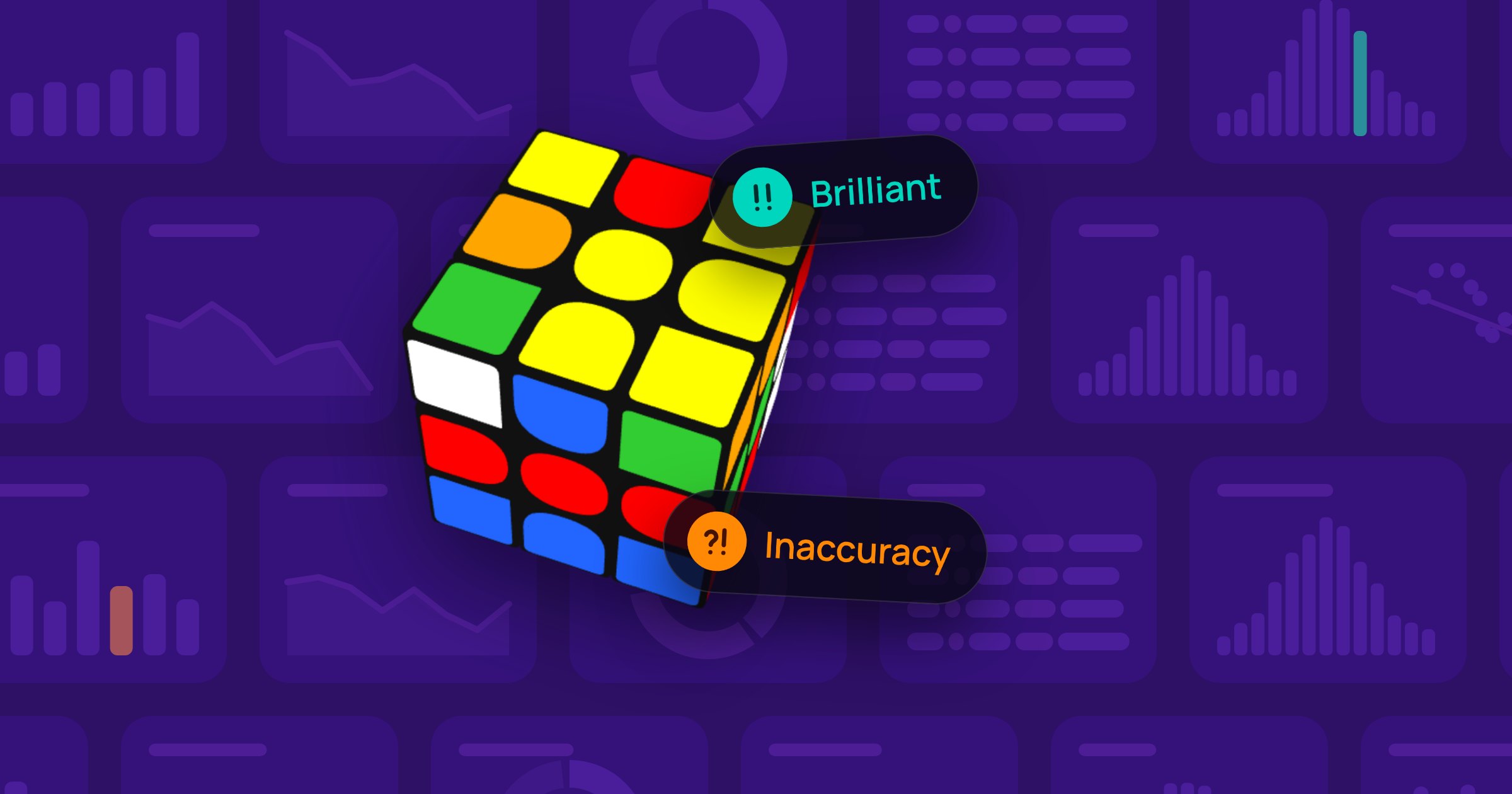
This is where a smart cube takes the place of the faster cuber watching you. The flaws they would have spotted, the missed opportunities, the algorithm choices worth revisiting: all of it is flagged on every solve, not once a year at a competition. You can also compare each step's time with other cubers at a given level, and see right away where you lose the most compared to them.
Practice for less time, but better
The second change is how you practice. Since the cube knows its own state, you can practice continuously: it knows when you have finished a case and offers a new one straight away. On your OLLs, PLLs or F2L pairs, you chain cases without touching the screen: the next one comes as soon as you have solved the last. Other drills isolate the cross or the xcross, with scrambles picked for the length you want to work on.
Twenty minutes on your weakest step then beats an hour of full solves where that step only shows up once in five. And since the stats are saved, you can see whether the work is paying off, week after week, instead of guessing.
What about the plain timer?
It isn't going anywhere. Competitions are still held with a regular cube and a timer, and nothing replaces full solves to get ready for one. A smart cube turns like a normal cube: it is the same practice, with an extra pair of eyes.
The difference is what you know at the end of a session. Before, you left with an average. With a smart cube, you leave with a precise list of what slows you down, and what to work on tomorrow.
Already have a smart cube? The connection guide shows how to link it to xcross.gg in a few steps, on the web, iOS and Android.